

By Shenella Deane.
Antigua and Barbuda, we need to have an uncomfortable conversation.
We keep talking about gun crime.
We talk about young people.
We talk about gangs.
We talk about illegal firearms.
We talk about locking people up.
We talk about tougher sentences.
And yes, all of those conversations matter.
But before we blame the youth, I think we need to ask ourselves a much harder question:
What have our young people been watching us do?
Because children don’t learn only from what we tell them.
They learn from what we demonstrate.
And if we’re honest with ourselves, some of what we are demonstrating as a society should concern us.
The gun is not where the story begins
A young person doesn’t wake up one morning and magically decide that violence is the answer.
There are usually lessons that come before the weapon.
Maybe they learned:
If somebody disrespects you, retaliate.
If you can’t get your way, intimidate them.
Being feared is better than being respected.
The loudest person wins.
If somebody embarrasses you, embarrass them back.
Walking away means you’re weak.
Money matters more than how you got it.
And sometimes those lessons don’t come from another young person.
They come from US Adults.
Look at our sporting environment.
Football fields, Cricketing Grounds, basketball courts etc ,should be one of the safest and most positive spaces for our children and youths.
It teaches teamwork.
Discipline.
Leadership.
Communication.
Competition.
How to win.
And, importantly, how to lose.
But what happens when a child/youth watches an adult screaming at a referee?
What happens when a coach humiliates an opposing player or the referee?
What happens when a parent threatens the referee because they don’t like a decision?
What happens when an adult becomes verbally abusive and everyone says:
“It’s just the emotion of the game, dem na mean nothing by it.”
The adult may believe the moment ends when the whistle blows.
The child may take the lesson home.
The child sees an adult become angry.
The adult insults someone.
People laugh.
Nobody intervenes.
The adult feels powerful.
And the game continues.
So what did the child learn?
That aggression works.
That’s the part we don’t talk about enough.
And it isn’t only at sporting venues.
We see it in community centres.
We see it in neighbourhoods.
We see it online.
We see it in schools.
We see it in public spaces.
People don’t get their way and immediately become hostile.
Someone feels disrespected and starts attacking the other person’s character.
People publicly humiliate one another.
People use vulgarity and sexual insults to degrade others.
People tell immigrants “A ya me barn” “Dem na come from ya” “Dem bang wata come ya”.
People threaten.
People intimidate.
And Most times, what’re the result of these displays?
People laugh.
Most times they encourage it.
Most times they join in.
And most times the excuse is simply:
“That’s just how people behave, dem na mean nothing by it.” But is it really?
No.
That’s exactly the problem.
We have normalized aggressive behaviour as a society.
What does a child learn when aggression gets applause?
Imagine being 13 years old and watching an adult publicly humiliate another person.
Nobody stops them.
Instead, people laugh.
Maybe someone records it.
Maybe the person becomes the centre of attention.
Maybe everybody talks about how “bad” or “fearless” they were.
That child doesn’t necessarily think:
“That adult behaved inappropriately.”
They may think:
“That person won.”
And that’s how behaviour gets normalized.
Because attention is reinforcement.
If intimidation gets you attention…
If aggression gets you admiration…
If disrespect gets you laughter…
If retaliation gets you status…
then some young people will learn to use those behaviours themselves.
And then, when they do it, we ask:
“What’s wrong with these youths?”
Maybe we should also ask ourselves:
“What have they been watching?”
We are teaching conflict resolution with our mouths while teaching aggression, discrimination and disrespect with our behaviour.
This may be one of the biggest contradictions in our society.
We tell young people:
“Use your words.”
“Walk away.”
“Respect others.”
“Control your anger.”
But then they watch adults do the exact opposite.
They watch adults lose control over a game.
They watch adults insult referees.
They watch adults threaten one another.
They watch adults use humiliation to win arguments.
They watch adults treat aggression as entertainment.
Then we expect a teenager to have better emotional regulation than the adults around them.
How?
Conflict resolution cannot simply be something we teach children in a classroom.
It has to be something they see adults practise.
Who are we calling role models?
We constantly say that our young people need mentors.
Absolutely.
But I have another question:
Who exactly are we putting in front of our kids?
Who are the coaches?
Who are the teachers?
Who are the community leaders?
Who are the older players?
Who are the people running youth programmes?
Who are the adults young men admire?
And who are their parents?
Because a title doesn’t automatically make someone a role model.
Someone can be a coach and still model aggression.
Someone can be a teacher and still use humiliation.
Someone can be a community leader and still be intimidating.
Someone can be a parent and still resolve every disagreement through aggression.
A child doesn’t absorb your title.
They absorb your behaviour.
And we need to be brave enough to examine the adults influencing our children and not just the children.
Then there is the economy.
This conversation also cannot ignore the cost of living.
Antigua’s economy has been growing, but economic growth at the national level doesn’t mean every household is financially comfortable. The IMF has acknowledged continuing cost-of-living pressures, while the government has been considering measures around wages and household affordability. (imf.org )
For some families, one job simply isn’t enough.
A parent, both parents or guardian works all day.
Then works another job in the night.
Then perhaps does side work on weekends.
Not because they don’t want to be present.
Because they are trying to provide.
So when we talk about “absent parents,” let’s be honest.
Sometimes the parent isn’t absent by choice.
They’re working.
They’re trying to keep the lights on.
They’re trying to pay rent.
They’re trying to buy food.
They’re trying to keep their children in school.
And a lot of times they’re fighting to receive wages they have already worked for.
For a household living paycheck to paycheck, delayed wages aren’t an inconvenience.
It’s a crisis.
And who fills the gap?
When parents are working multiple jobs, who is around the child?
The older friend.
The neighbourhood.
The coach.
The older sibling.
The social-media personality.
The person with money.
The person with status.
The person who appears fearless.
The person who can provide what the child wants or needs.
And if that person is involved in criminal activity, they aren’t simply offering friendship.
They may be offering:
money, belonging, protection, identity and status.
That is powerful.
Now let’s talk about fast money.
Imagine a young person watching their mother or father or both parents work him/herself to exhaustion and still struggle.
Then someone offers them quick money.
I’m not saying that makes robbery acceptable.
It doesn’t.
I’m saying we need to understand why the offer can become attractive.
Some young people may also feel pressure to help their household.
They may want to contribute.
They may want to help a parent who is struggling.
They may want things they see others enjoying.
And the illegal economy can make money appear much faster than legitimate employment.
If we want young people to choose the legitimate route, then the legitimate route must offer them a realistic pathway to dignity, income, belonging and success.
But none of these that I am mentioning excuses crime.
Let’s make that absolutely clear.
Being poor doesn’t make someone a criminal.
Having absent parents doesn’t make someone a criminal.
Being angry doesn’t make someone a criminal.
Having a difficult childhood doesn’t make someone a criminal.
And economic hardship does not excuse robbery, assault or murder.
Personal responsibility still matters.
But prevention requires us to understand the environment in which decisions are being made.
If we only punish the final act, we may never change the conditions that keep producing the same behaviour.
Then we come to the gun.
The gun changes everything.
An argument that once ended with two people cursing each other can now end with someone being shot.
A dispute that could have been resolved can become a murder.
So yes:
Get illegal guns off our streets.
Investigate trafficking.
Strengthen intelligence.
Improve firearm tracing.
Prosecute serious firearm offences.
Hold repeat offenders accountable.
Protect communities.
But don’t stop there.
Because the firearm is often the final link in a much longer chain.
Look at the repeat offenders.
Recent police figures reported that 148 of the 260 people arrested and charged between January and May 2026 were identified as repeat offenders. (antiguaobserver.com )
That should force us to ask:
What happens after the first offence?
Are we simply arresting the same people over and over?
Are they returning to the same environment?
Are they reconnecting with the same networks?
Are they influencing younger people?
Are younger people being recruited by individuals who already have a history of violence?
If so, we need targeted intervention.
Not just broad programmes.
Targeted intervention.
We need to stop asking only, “What’s wrong with the youths?”
Ask:
Who influenced them?
Who mentored them?
What did they see at home?
What did they see at school?
What did they see at the football field?
What did they see at the community centre?
Who did they admire?
How did those adults behave when they were angry?
Was their parent working two jobs?
Were they struggling financially?
Were their wages being paid?
Did they have legitimate opportunities to earn?
Did anyone teach them how to resolve conflict?
Who taught them that being feared equals being respected?
These questions don’t excuse criminal behaviour.
They help us prevent it.
This is not just a Police problem.
The Police have an essential role.
But we cannot police our way out of a social environment that keeps reproducing violence.
This requires:
National Security, Education,Youth Affairs, Sports, Culture, Labour, Social Development, Schools, Families, Community organizations, Coaches, Teachers, Parents And the wider John Public.
EVERYONE has a role.
Because the Police cannot arrest a culture.
They cannot arrest economic pressure.
They cannot arrest a parent who has to work two jobs.
They cannot arrest a coach who models intimidation.
They cannot arrest a community that laughs when someone is publicly humiliated.
They cannot arrest a child who has learned that aggression gets attention.
Those are social problems.
And social problems require social solutions.
We need to change what earns respect.
This may be the heart of the issue.
What do we reward?
The person who is feared?
Or the person who is disciplined?
The person who gets the last word?
Or the person who knows when to walk away?
The person who flashes money?
Or the person who builds something legitimately?
The person who intimidates?
Or the person who leads?
The person who can fight?
Or the person who can control himself when he is angry?
Because young people are watching.
They are ALWAYS watching.
Before a child learns to pull a trigger, they may first learn something else👇🏾
They may learn that disrespect deserves retaliation.
They may learn that intimidation gets results.
They may learn that aggression makes people laugh.
They may learn that violence makes you powerful.
They may learn that money is more important than integrity.
They may learn that walking away makes you weak.
They may learn that nobody cares unless you make them afraid.
And if those are the lessons surrounding them long enough, we cannot act surprised when some eventually take those lessons to a dangerous place.
The gun may be the final weapon.
But the first weapon may have been the lesson.
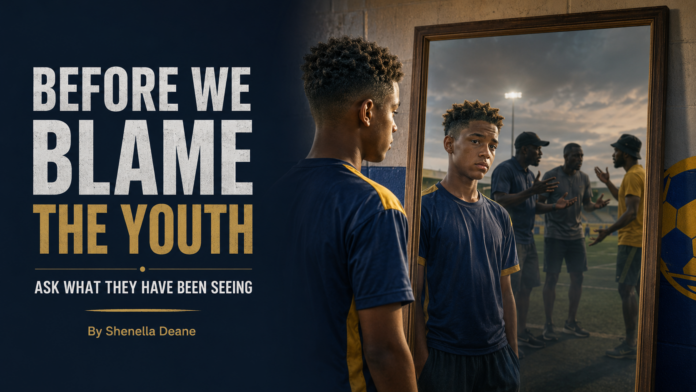
So before we blame the youth, let’s look in the mirror.
Before we demand tougher children, LET’S DEMAND BETTER EXAMPLES.
Before we say “these young people have no respect,” let’s examine how adults demonstrate respect.
Before we ask why they can’t resolve conflict, let’s examine how we(adults) resolve ours.
Before we ask why they want fast money, let’s examine whether legitimate work is allowing families to live with dignity.
Before we ask who is influencing our children, let’s examine the people we have placed around them.
And before we remove another gun from another young person’s hand, let’s ask ourselves:
What can we change in this country so that fewer young people ever believe they need one?
Because Antigua and Barbuda does not just need fewer guns.
We need fewer reasons for our children to believe that violence is the language of power.
And that responsibility belongs to all of us the estimated 95 thousand+ people of this population.
By Shenella Deane.
This article was originally published by Antigua News Room. Read the original article here: OPINION: Before We Blame the Youth, Ask What They Have Been Seeing?.