
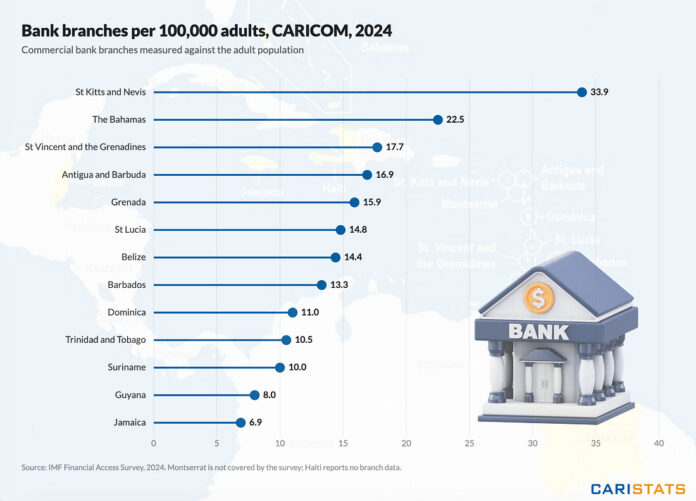

For Caribbean households and small businesses that still bank in person – depositing cash, arranging a loan, paying a bill – the number of branches within reach is a practical measure of access.
In 2024, commercial bank branches per 100,000 adults ran higher in the smallest states – St Kitts and Nevis at 33.9, The Bahamas at 22.5, St Vincent and the Grenadines at 17.7 – and lower among the larger populations: Jamaica 6.9, Guyana 8.0 and Suriname 10.0. Much of that gap reflects population size, not banking depth.
The more telling shift is over time. The region’s median fell from about 21 branches per 100,000 adults in 2014 to roughly 14 in 2024, with declines in 12 of the 13 members reporting both years. The decline reflects fewer branches, not simply a larger population.
Jamaica was the exception, the only member to add branches over the period. St Kitts and Nevis shows the other side: near the top of the chart today, it counted 51.2 branches per 100,000 adults a decade ago.
Source : International Monetary Fund Financial Access Survey, 2024 (2014 shown for comparison). Commercial bank branches per 100,000 adults. Thirteen members reported for both years.
This article was originally published by Antigua News Room. Read the original article here: Banking Within Reach: How Branch Access Varies Across CARICOM.