

Demographic divergence across CARICOM is creating two distinct economic futures
A country’s age structure is a quiet forecast. It signals whether the coming decade brings a widening workforce or a rising care burden, and across CARICOM, that forecast is now splitting in two.
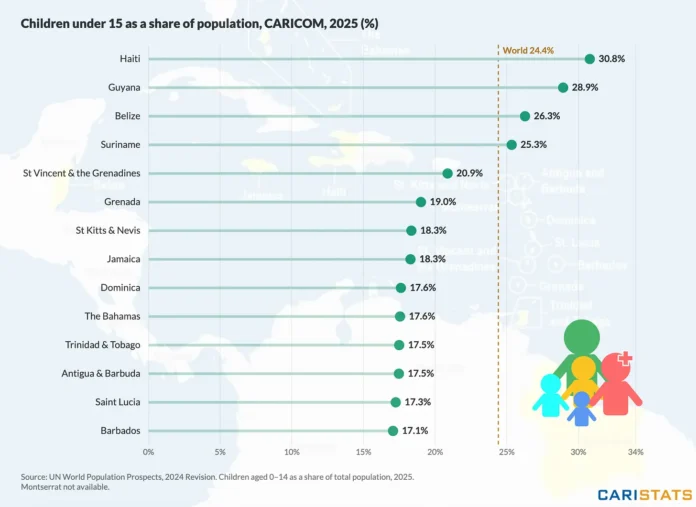
In 2025, children under 15 still made up close to a third of the population in Guyana and Haiti (28.9% and 30.8%), with Belize and Suriname in the mid-20s. In these economies, a large young base is still moving toward working age.
Saint Vincent and the Grenadines, at 20.9%, sits between the two ends. Nine members cluster lower, near 17-19%, among them Barbados, Trinidad and Tobago and Saint Lucia. These figures mirror the age profiles of the United Kingdom and the United States.
What comes next differs sharply across this range. Where children make up a quarter or more of the population, the immediate priority is expanding education and creating job capacity for incoming cohorts. Where youth sits near a sixth of the population, school enrollments decline first, followed a decade later by smaller generations entering the workforce. For those aging economies, growth can no longer rely on expansion by numbers alone – it will depend on productivity gains, automation, and immigration.
Source: UN World Population Prospects, 2024 Revision. Children aged 0-14 as a share of total population, 2025. Montserrat not available.
This article was originally published by Antigua News Room. Read the original article here: How Much of Each Caribbean Population Is Under 15.