
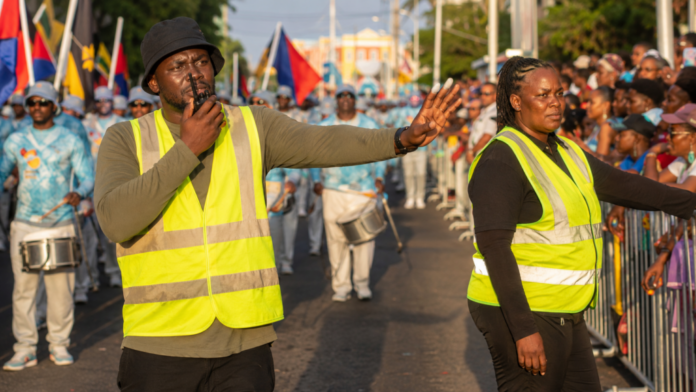

As another successful Antigua Carnival comes to a close, expressions of gratitude have once again begun to pour in. Each year, well-deserved recognition is given to the Antigua and Barbuda Festival Commission, the Royal Police Force of Antigua and Barbuda, the Antigua and Barbuda Defence Force, emergency services, members of the media, vendors, sponsors, and the many visitors who choose our island as their Carnival destination. But there is one group that continues to operate largely in the shadows; the Parade Marshals.
While thousands of people take to the streets to enjoy the spectacle, Parade Marshals are already hard at work hours before the first band moves. They are on the parade route early, coordinating positions, communicating with organizers, assisting with the movement of bands, managing crowds, and preparing to deal with whatever challenges may arise. And they remain there until the very end.
Contrary to what some members of the public think, the job of parade marshals is not simply to walk alongside a band or direct traffic. They are responsible for helping to maintain the flow and integrity of the parade while working with police, emergency personnel, band leaders and other stakeholders. They are constantly monitoring what is happening around them and making decisions in real time to keep the parade moving safely and efficiently.
What is often overlooked, however, is the treatment some marshals receive while carrying out these duties. There are times when spectators verbally abuse marshals because they are asked to move from an area where they should not occupy or they disagree with a decision taken by a marshal. There are also occasions when marshals face aggressive and at times physical confrontations while simply trying to do the job they were assigned to do. Perhaps even more frustrating is what happens when the parade itself begins to experience delays.
One of the fundamental responsibilities of a marshal is to maintain the flow of the parade. Yet there are occasions when some mas camps, bands, or participants deliberately slow down or hold up the procession, creating significant gaps between sections. Marshals may repeatedly instruct them to keep moving, but when those instructions are ignored, the resulting gaps are sometimes blamed on the very marshals who were attempting to prevent them in the first place. This raises an important question: How can marshals be expected to maintain a seamless parade when some participants deliberately refuse to cooperate with the instructions given to them?
Marshals cannot be everywhere at once, nor can they physically force an entire section of a parade to move at the required pace. They can communicate, instruct, monitor, report and intervene where necessary but the success of the parade also depends on the cooperation of bands, mas camps, participants, spectators and other stakeholders. It is therefore unfair to place the blame solely on marshals when delays are caused by individuals or groups who refuse to follow the established procedures.
Despite these challenges, marshals continue to show up. They work in the heat. They work through the night. They walk for hours. They deal with difficult spectators. They manage frustrated participants. They respond when situations become tense. And, in some instances, they put themselves directly in harm’s way to protect others and keep the parade moving.
When the last band crosses the finish line, the spectators begin heading home and the streets start to empty, the marshals are still working. Their responsibility does not end simply because the music has stopped. They remain until their duties are completed and the parade operation has come to an end.
The irony is that when marshals do their job successfully, their work is almost invisible. If the parade moves smoothly, everyone simply enjoys the show. If something goes wrong, however, the marshals are often among the first people to receive criticism. Do not get me wrong, marshals do have areas for improvement and efforts have been made every year to do just that.
The attitude towards marshals needs to change.
Recognition should not only be given to those whose contributions are highly visible. It must also be given to the people working behind the scenes to ensure that the festival functions safely and efficiently. The Parade Marshals deserve appreciation not only for the hours they dedicate, but also for the abuse they sometimes endure, the difficult situations they manage and the personal risks they take in the execution of their responsibilities.
As Antigua and Barbuda celebrates the success of another Carnival, perhaps it is time we ask ourselves why the people responsible for helping to keep our parades safe, organised and moving are so often absent from the list of those publicly thanked.
To every Parade Marshal who reported for duty before sunrise, remained on the streets for hours, dealt with difficult situations, absorbed criticism, faced verbal or physical aggression, and still remained committed to getting the job done, thank you.
Your contribution matters. You are not simply people wearing a vest and walking along a parade route. You are an essential part of the machinery that allows Antigua Carnival to function. It is time that the nation recognizes the Parade Marshals not as an afterthought, but as the indispensable part of Carnival that they truly are.
Written by
A previous parade marshal One who feels it
M.B
This article was originally published by Antigua News Room. Read the original article here: OPINION: It’s Time We Recognize Antigua Carnival’s Unsung Heroes.