
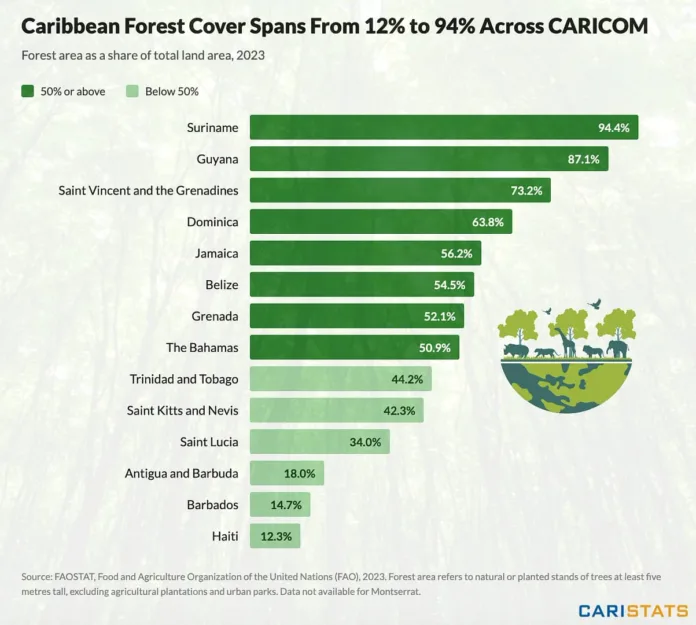

Forest cover across CARICOM ranged from 12% to 94% of total land area in 2023, according to estimates published by the Food and Agriculture Organization of the United Nations (FAO).
Suriname (94.4%) and Guyana (87.1%) place among the most forested countries in the world – a regional position that rarely features in economic discussions of the Caribbean. Their forest cover exceeds that of major rainforest economies including Brazil and Indonesia.
Saint Vincent and the Grenadines (73.2%) and Dominica (63.8%) follow at the upper end. Jamaica, Belize, Grenada and The Bahamas all report forest cover between 50% and 57%, while Trinidad and Tobago, Saint Kitts and Nevis and Saint Lucia sit in the mid-range.
Antigua and Barbuda and Barbados fall at the lower end of the regional distribution.
Much of the spread reflects geography and ecological context – land area, terrain and historical land use vary substantially across the region. Across CARICOM, forests anchor biodiversity, watershed protection and a growing role in carbon markets and climate finance.
Source : FAOSTAT, Food and Agriculture Organization of the United Nations (FAO), 2023. Forest area refers to natural or planted stands of trees at least five metres tall, excluding agricultural plantations and urban parks. Data not available for Montserrat.