
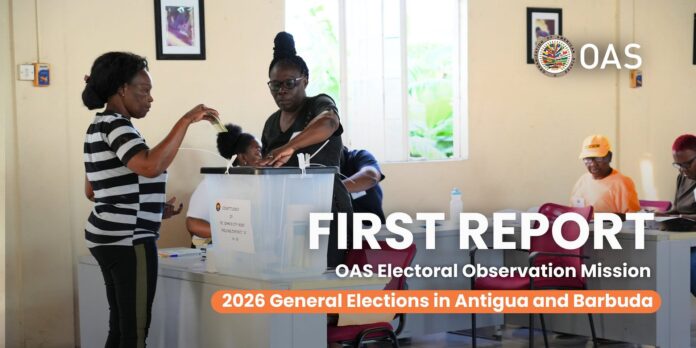

The Organization of American States (OAS) has commended Antigua and Barbuda for conducting “transparent and orderly” general elections on April 30, while highlighting declining voter turnout and structural challenges within the electoral system.
In its first report released May 1, the OAS Electoral Observation Mission said the vote unfolded calmly and efficiently across all 17 constituencies, with polling stations opening on time and election workers demonstrating strong procedural knowledge.
Observers monitored 178 polling stations and reported that voters were able to cast ballots in an organized environment, with clear signage and assistance available throughout the day.
The Mission praised the professionalism of poll workers, police, and electoral officials, noting that the process adhered fully to established laws and procedures.
However, the report pointed to a notable decline in voter participation. Turnout stood at 62.41% , down from 70.34% in the 2023 general elections , a drop of nearly eight percentage points.
The results saw the ruling Antigua and Barbuda Labour Party (ABLP) secure 15 of 17 seats , with the United Progressive Party (UPP) and Barbuda People’s Movement (BPM) each winning one constituency.
Pre-election pressures and voter ID surge
The Mission noted that much of the pre-election period was dominated by a rush for voter identification cards, as IDs issued in 2014 began expiring in 2024.
More than 32,000 applications for replacement voter IDs were submitted, with completion rates varying significantly across constituencies—from 93% in St. Peter to 61% in St. Mary’s North.
To address the demand, the Antigua and Barbuda Electoral Commission (ABEC) extended office hours and allowed voters without IDs to obtain temporary, single-use cards on Election Day.
Concerns over voter apathy and snap election timing
Despite the smooth process, the OAS flagged concerns raised by stakeholders about voter apathy , which some attributed to fatigue from frequent elections and by-elections.
The Mission also noted debate over the timing of the election, which followed the dissolution of Parliament on April 1. Stakeholders said the short campaign period may have disadvantaged some candidates and parties in organizing effectively.
Accessibility and operational strengths
Observers highlighted improvements in accessibility, including efforts to locate polling stations on ground floors. However, some challenges remained due to terrain and distance within certain locations.
Overall, the Mission concluded that the election reflected strong civic engagement and institutional professionalism, even as it underscored areas requiring reform to strengthen participation and equity in future elections.