
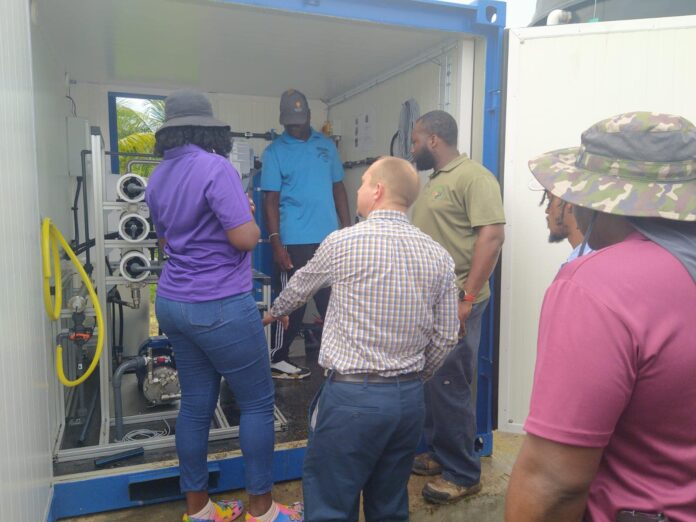

The Blubber Valley Osmosis Plant has reached a key milestone under the solar-powered desalination initiative, a partnership between the Food and Agriculture Organization (FAO) of the United Nations, the Ministry of Agriculture, and Texas Tech University.
Professor Shane Walker, from the Department of Civil, Environmental, and Construction Engineering at Texas Tech University, explained that the project demonstrates solar-powered reverse osmosis technology for converting brackish groundwater into usable irrigation water for Antigua and Barbuda’s priority crops.
The system draws water from a nearby APUA well. The brackish water is first collected in a holding tank, then processed through the reverse osmosis unit, and finally stored for agricultural use. Each full cycle produces roughly 2,000 gallons of low-salinity permeate and 1,000 gallons of brine concentrate.
While the permeate is well suited for crop irrigation, Professor Walker noted that the management of the brine will be critical to avoid salt buildup in the soil over time. The Ministry’s technical team is therefore exploring salt-tolerant crops that can utilize slightly brinier water without long-term soil degradation.
Given Antigua’s distinct soil types—calciferous in the north, clay-heavy in the central plains, and volcanic in the south—the system’s performance will be evaluated across these regions to determine the most effective agricultural applications.
Professor Walker expressed appreciation to APUA for its support in providing the well and pumping infrastructure that made the project possible. “With both the solar array and desalination plant now fully operational, the next phase involves engaging farmers directly to put the technology to productive use, helping to strengthen the nation’s water security and agricultural resilience,” he said.
According to Luke Nedd, FAO National Project Coordinator, the initiative aligns with FAO’s broader goal of promoting climate-smart and sustainable agricultural practices across the region.
“This project represents a forward step in helping our farmers adapt to changing conditions,” Nedd said. “By harnessing renewable energy to produce irrigation water, we’re showing that innovation and sustainability can go hand in hand in building a more resilient agricultural sector.”