
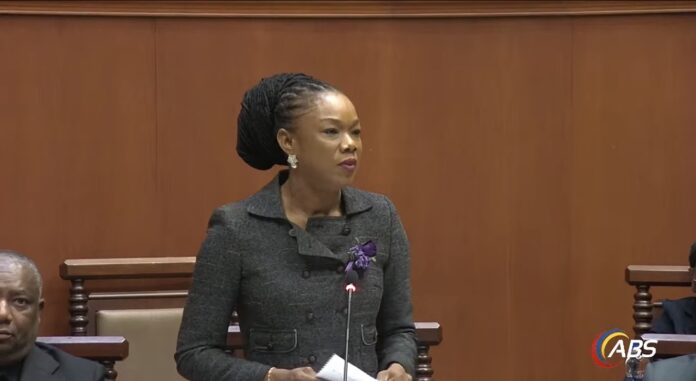

Opposition Senator Malaka Parker has warned that political power, public office and social standing must never be allowed to shield people accused of sexually abusing children.
In a forceful contribution to the Senate’s debate on the Sexual Offences Amendment Bill, 2026, Parker said Antigua and Barbuda could not honestly confront child sexual abuse while remaining silent about alleged misconduct involving influential people.
She referred broadly to what she described as a troubling national history involving politicians and the sexual violation of children, but she did not identify any alleged offender or present evidence against a specific person.
Parker argued that attaining high office could not erase a person’s past or give politicians the authority to dictate what the public should believe.
“Some people think that time, power and position can erase who they are,” she said.
Her remarks drew an objection from the government benches, where the Vice President of the Senate Phillip Shoul accused her of repeatedly referring to predators in political office without presenting evidence.
Senate President Alincia Williams-Grant agreed that Parker had made a broad statement without providing supporting information and reminded her that statements made inside Parliament were held to a higher standard.
Before the intervention, Parker had argued that men in positions of authority could exercise control over homes, institutions and offices, including political offices, while believing themselves immune from scrutiny.
She did not withdraw her broader warning that status and influence should not protect suspected offenders.
Parker also spoke about public attacks she said she had endured concerning her personal life. She rejected what she characterized as moral lectures from politicians and said she would not be intimidated into silence.
“I have a history. I have a past,” Parker said. “I can stand tall. I cannot be intimidated, never, into silence.”
Her political criticism formed part of a wider contribution focused on the silence surrounding child sexual abuse and the long-term suffering of survivors.
Parker said abused children often grew into traumatized adults who carried their experiences privately because of shame, intimidation and fear.
Some survivors, she said, were forced to continue living around their alleged abusers, including relatives, caregivers, religious figures and other trusted adults.
She said child sexual abuse crossed social and economic boundaries and rejected the belief that predators came only from poor or troubled households.
Parker recalled serving as social transformation minister and said she had directly encountered mothers and children affected by sexual abuse.
She described meeting children who were not believed after reporting abuse and families in which adults protected the household’s male provider instead of the child.
“These are real social issues,” she said. “They cut across class.”
Parker said those experiences drove her to launch a yearlong national campaign against child abuse while in office.
The campaign, called the Innocence Project, used the message “Break the Silence” and involved schools, entertainers, psychologists, dancers, religious figures and other community members.
Parker said the initiative reached more than 20 schools and used age-appropriate sexual education to help children recognize improper behavior, understand personal boundaries and report abuse.
She said students and teachers frequently approached members of the campaign team after school presentations to disclose concerns or share personal experiences.
Parker argued that public education and early detection were essential because punishment occurred only after a child had already been harmed.
“The best deterrent to a sexual predator is the fear of being apprehended or detected,” she said.
The former minister said she also enlisted senators and participants in a national queen show to record public-service messages about child abuse. She said she unsuccessfully attempted to secure similar participation from politicians in the Lower House.
Parker suggested that some politicians may have been uncomfortable publicly associating themselves with the campaign, but she did not identify them or provide evidence explaining why they did not participate.
She used her record on child protection to challenge politicians she accused of only recently recognizing the seriousness of the problem.
Parker nevertheless supported several provisions in the Sexual Offences Amendment Bill.
She welcomed the removal of distinctions between male and female offenders, arguing that women who sexually abuse children must face the same treatment as male perpetrators.
“They must be equal under the law,” Parker said. “They’re equally bad.”
She also supported provisions addressing delayed reports of sexual abuse. Parker said victims should not be treated as unreliable merely because they did not report an offense immediately or tell another person at the time.
Many survivors remain silent for years because of fear, dependence, trauma or pressure from relatives, she said.
Parker argued that the amendment should go further by expressly declaring that there is no statute of limitations for child sexual abuse.
“Just as it is with murder, 50 years later, the crime can be solved,” she said.
She also called for the age of consent to be increased from 16 to 18, saying Antigua and Barbuda’s sexual-offense laws should be consistent with other legislation that defines a child as anyone younger than 18.
Parker said the country should stop repeatedly discussing the change and enact it.
“Let us raise the age of consent and stop talking about it,” she said.
She further called for renewed attention to wider child-protection legislation, arguing that tougher prison sentences addressed punishment but did not provide a complete system for preventing abuse and protecting vulnerable children.
Parker said legislation dealing with child justice and child care should be updated alongside the Sexual Offences Act.
Her contribution ultimately challenged Parliament to apply child-protection standards consistently, including when allegations involve politicians or people with institutional authority and influence.
This article was originally published by Antigua News Room. Read the original article here: Parker warns political power must not shield child sexual abuse.