
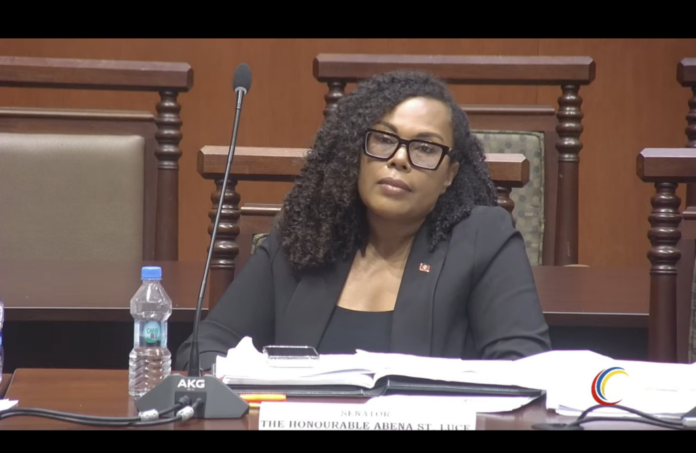

Government Senator Abena St. Luce has described child sexual abuse as a long-standing “dirty secret” in Antigua and Barbuda, warning that stronger prison sentences alone will not protect children unless the country also confronts victim-blaming, improves support for survivors and closely monitors convicted offenders after their release.
Speaking during the Senate’s debate on the Sexual Offences Amendment Bill, 2026, St. Luce said the deeply personal accounts shared by women in the chamber demonstrated that the abuse of children was neither new nor confined to any particular type of household.
“This has been a dirty secret within our society for a very long time,” she said. “For grown women to be able to sit in this honorable House and tell these personal stories tells us this has been going on for quite some time.”
Her remarks followed an emotional disclosure from Independent Senator Jamilla Kirwan, who spoke publicly during the debate about being sexually abused as a child.
St. Luce praised survivors who found the courage to tell their stories, acknowledging that speaking publicly about childhood abuse could be painful and difficult. She argued, however, that exposing what had traditionally been hidden was necessary if the country hoped to protect other children.
“If we are going to fight these things, we do have to shine light on it,” she said.
St. Luce said even people who had not personally experienced sexual abuse were likely to know relatives, friends or neighbors who had. Recalling her own childhood, she said some of her friends had told her about men sexually interfering with them, including children whose fathers were police officers.
She made clear that she was not accusing those officers of abusing their children. Instead, she said their experience demonstrated that no family’s status, profession or structure could guarantee that a child would be safe from a determined predator.
“How does a predator get past the police, right into the household where their child was supposed to be the safest child in Antigua?” she asked.
St. Luce challenged the belief that offenders primarily target children from poor, single-parent or struggling households. Financial hardship and family instability may create vulnerabilities, she said, but predators ultimately target children wherever they can gain access.
“Wherever there’s a child, there’s a potential victim,” she said. “Predators don’t look for details. They look for children.”
While giving her full support to the amendment bill, St. Luce cautioned that its passage should not be treated as the end of the national response.
“This amendment is only one step in bringing this trouble to an end,” she said.
She identified punishment, prevention, survivor support and the supervision of offenders as essential parts of a broader strategy.
St. Luce said prevention must extend beyond teaching children about appropriate and inappropriate touching or instructing them to tell an adult if they are abused. Adults must also change how they respond to children whose conduct may indicate trauma, she said.
She criticized people who label young girls as “fast” or sexually promiscuous because of their clothing or behavior, arguing that such conduct may be a child’s expression of pain or a plea for help.
“That is a child that’s in pain,” she said. “That child did not come into the world and decide to act this way. That is a call for help, and we’re ignoring it and we’re judging the victim.”
She warned that children who hear adults blaming other victims may become afraid to disclose their own experiences.
“We cannot look at victims and say at any point it is their fault,” St. Luce said. “They are children.”
The senator also criticized what she described as a broader culture of silence around sexual crimes. She said communities often resist bad news, particularly allegations of sexual abuse, because families do not want to believe it could happen inside their own homes.
“We bury our heads in the sand,” she said. “Especially things like this — anything with sex crimes, we tend to want to hide from that and say, ‘Not my household, not my children, not me.’ Yes, your household, your children, you.”
St. Luce said child advocates had sounded alarms for years, but the wider public only recently began paying closer attention to sentences imposed in sexual-offense cases. She said scrutiny intensified during the public debate over gun crime and what many people considered lenient sentences for firearm offenses.
That discussion eventually turned to penalties imposed on people convicted of sexually abusing children, she said.
St. Luce recounted a case she said she had read about involving a 56-year-old man who repeatedly sexually assaulted his 5-year-old great-niece and threatened to kill the child’s mother if she disclosed the abuse.
The man received a sentence of five years and three months, she said.
“The child is 5,” St. Luce said. “Before she reaches puberty, this man would be out and about.”
She questioned how a sentence could fall so far below the maximum penalty of life imprisonment. St. Luce criticized sentencing reductions based on guilty pleas, time saved by avoiding a trial and the absence of previous convictions.
She argued that a clean criminal record did not necessarily mean an offender had never abused another child, only that there may have been no earlier conviction.
“How would you know if he’s done it before?” she asked. “He could have done it 100 times before. We don’t know.”
St. Luce also cited a reported case involving a man in his 20s who received three years in prison for sexually abusing a 12-year-old girl, then allegedly used a similar method to abuse another child after his release and received six years.
She said sentences of two, three or five years could allow offenders to return to the community while their victims were still children.
“When you give these light sentences, it’s almost like it’s an invitation,” she said. “Like you’re saying it’s OK.”
The senator welcomed the bill’s establishment of a minimum sentencing floor. Under her explanation of the amendment, courts would generally be prohibited from imposing a sentence below 50% of the maximum penalty after applying the relevant sentencing calculations.
Where the maximum is treated as 30 years, she said, the resulting minimum would be 15 years.
St. Luce argued that the longer period would give survivors more time to obtain assistance and rebuild their lives before encountering their abusers again.
She also welcomed the proposed increase in the penalty for indecent assault, explaining that the offense included unwanted sexual touching. She initially referenced a 25-year penalty before correcting herself and saying the amendment would replace the existing five-year term with 20 years.
“Gone are the days where it’s all fun and games if you do a little smack,” she said. “No, sorry. That is sexual assault. You must stop.”
St. Luce praised the legislation for treating victims and perpetrators without regard to gender. She said boys must receive the same protection as girls and women who abuse children must be treated as offenders rather than having their conduct dismissed or sexualized.
“A child is a child is a child,” she said. “It doesn’t matter the gender. A minor is a minor. A victim is a victim.”
She criticized adults who treat sexualized interactions between women and young boys as amusing, including when boys are seen dancing against adult women during Carnival.
“It is wrong,” she said. “I don’t care what the little boy says. It is wrong. Do better.”
St. Luce joined other senators in calling for Antigua and Barbuda’s age of sexual consent to be increased from 16 to 18.
She referred to her teenage son and daughter as examples of young people who, despite approaching adulthood, remained dependent on their parents and focused on school.
“My son is going to be 16,” she said. “He can’t consent to anything. Not because there’s anything wrong with him, but he’s a child at the end of the day.”
She argued that it was inconsistent to recognize 18 as the age at which young people could vote and exercise other adult responsibilities while maintaining an age of consent of 16.
“It is 2026,” she said. “We all have dealt with children enough to know the age of consent cannot be 16. It needs to be 18.”
Beyond prosecution and punishment, St. Luce called for counseling to become more affordable and accessible to survivors. She said the country must overcome the stigma associated with seeking professional mental health care.
“There’s no shame in saying, ‘I need to talk to somebody,’” she said.
St. Luce called for counseling to be offered free or on a sliding scale based on a person’s ability to pay. She said she supported the pending mental health legislation but wanted provisions addressing access to counseling to be accelerated.
The senator also warned that the amended penalties would not apply retroactively to people already convicted of sexual offenses. That means Antigua and Barbuda must determine how to monitor offenders who have completed or are serving sentences under the existing law, she said.
St. Luce supported making the sex offender registry public, arguing that communities should be able to help monitor convicted predators because police officers cannot be everywhere.
She said convicted child sex offenders should be barred from schools, Carnival bands, sporting facilities and jobs that place them near children. She also called for restrictions preventing them from working with other vulnerable groups, including elderly nursing-home residents and hospital patients unable to protect themselves.
“They should not be allowed around those people, period,” she said.
St. Luce additionally proposed involving young people in developing technology to monitor convicted offenders. She said such a project could empower children by allowing them to participate in creating systems intended to protect them.
Young people must also be given safe spaces to speak with one another and trusted adults, she said.
St. Luce described her daily routine of combing her daughter’s hair and using that time to ask about school, friendships and problems affecting other children. Those conversations, she said, had alerted her to troubling incidents, including adults using social media to contact 11-year-old girls, obtain photographs and then threaten or blackmail them.
She said children sometimes disclose problems to friends before approaching adults. Parents must therefore be prepared to help children beyond their immediate families, including by contacting school counselors or other professionals when warning signs emerge.
“You’re not the parent just to your child,” St. Luce said. “You’re the parent to all the children around you.”
She ended her contribution by giving her complete support to the Sexual Offences Amendment Bill, while insisting that legislation must be accompanied by prevention, counseling, public education and continued supervision of convicted offenders.
“We cannot be selfish as parents,” she said. “When you see another child out there and they’re in trouble, play a part in trying to help them.”
This article was originally published by Antigua News Room. Read the original article here: St. Luce: Antigua and Barbuda must stop blaming sexually abused children.