
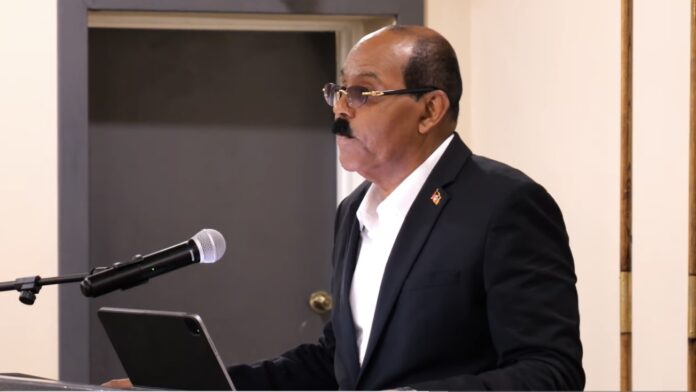

Prime Minister Gaston Browne has warned that increasingly sophisticated maritime fraud and sanctions evasion threaten the integrity of the global shipping industry, calling for stronger international cooperation to combat emerging risks.
Addressing the 2026 Global Maritime Security and Sanctions Enforcement Symposium at St James’s Club, Browne said governments and maritime authorities are confronting a growing range of illicit practices, including automatic identification system (AIS) spoofing, deceptive shipping practices, flag hopping, shell ownership structures and fraudulent vessel registries.
“We have witnessed the growing use of automatic identification system manipulation, deceptive shipping practices, flag hopping, shell ownership structures, and fraudulent registries designed to obscure illicit activities,” Browne told delegates.
He said these activities undermine not only sanctions regimes but also the broader international maritime governance framework that supports global commerce.
“The challenge before us is therefore not merely one of enforcement. It is fundamentally a challenge of governance,” Browne said, adding that transparency, accountability, due diligence and international cooperation must remain stronger than those seeking to exploit weaknesses in the system.
The prime minister noted that more than 80 percent of global trade is transported by sea, making the security and integrity of maritime commerce essential to energy markets, supply chains, food security and economic stability worldwide.
Browne said Antigua and Barbuda has strengthened the compliance systems and due diligence procedures of the Antigua and Barbuda Department of Marine Services and Merchant Shipping (ADOMS), describing strong regulatory oversight as critical to maintaining a credible shipping registry.
“Our experience has demonstrated a simple but powerful truth. Strong compliance frameworks are not obstacles to growth. They are prerequisites for sustainable growth,” he said.
He also urged countries to increase information sharing through initiatives such as the Registry Information Sharing Compact (RISC), arguing that closer cooperation between jurisdictions is one of the most effective ways to detect illicit maritime activity and prevent bad actors from exploiting regulatory gaps.
The symposium, hosted jointly by ADOMS and the United States Department of State, brought together government officials, maritime regulators and international organizations to discuss sanctions enforcement and maritime security.
This article was originally published by Antigua News Room. Read the original article here: PM Browne Warns of Growing Threat from Shadow Fleets and Maritime Fraud.