
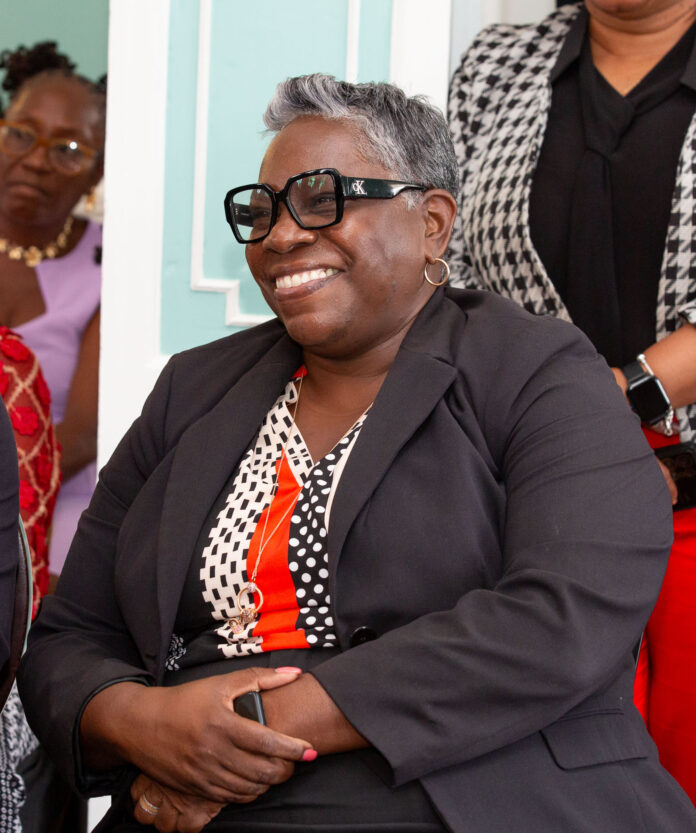

Former government minister and attorney Samantha Marshall has defended the Government’s decision to make first-degree tertiary education free, describing the policy as a strategic investment in national development rather than a political promise.
In an opinion piece, Marshall argued that the initiative transcends politics and is aimed at expanding opportunities for young people while strengthening Antigua and Barbuda’s human capital. She also defended the decision to offer the Bachelor of Laws (LLB) programme at reduced cost, saying greater access to higher education would benefit the country for generations.
Marshall criticized opponents of the policy, contending that many of the same voices had previously opposed the establishment of the The University of the West Indies at its current location. She noted that despite those objections, the campus has produced nearly 500 graduates since opening in 2019.
“The site they deemed unsuitable has since produced nearly 500 graduands,” she wrote, arguing that the institution has become a key contributor to national development.
She also pointed to the Government’s decision to fully fund Caribbean Secondary Education Certificate (CSEC) examination fees as evidence of a broader commitment to expanding educational opportunities.
According to Marshall, free tertiary education should not be viewed as charity or political expediency but as a long-term investment in developing professionals, entrepreneurs and public servants capable of driving economic and social progress.
“The question is not whether we can afford to do this,” she wrote. “The question is whether Antigua and Barbuda can afford not to.”
Marshall maintained that removing financial barriers to education would empower individuals, strengthen institutions and contribute to the country’s future growth.
READ FULL OPINION POSTED BY AMBASSADOR SAMANTHA MARHSALL VIA FACEBOOk
Free Tertiary Education: An Investment in People, Not a Political Promise
There are moments in governance when a policy transcends politics and speaks directly to the aspirations of a people. The Government’s initiative to make first-degree tertiary education fully free – and the LLB in Law accessible at half the cost – is precisely one of those moments.
And yet, predictably, the critics have arrived.
The opposition voices raise familiar arguments: that this cannot be sustained; that we have promised more than we can deliver; that free education is a dream dressed up as policy. What is conspicuously absent from that criticism, however, is any meaningful alternative. It is far easier to stand on the sidelines and question the vision of others than to offer one of your own.
What makes their argument even more remarkable is its consistency – and I do not mean this in a flattering way. These are not new voices of caution. These are the same voices that once objected to the very establishment of the University of the West Indies Five Islands Campus at its current site. The location was not their preference. The vision was not their own. And so they opposed it.
But here is what that opposition could not stop: RESULTS!
The site they deemed unsuitable has since produced nearly 500 graduands – many of whom are sons and daughters of Antigua and Barbuda – who have gone on to advance our nation’s human resource capacity, strengthen our institutions, and contribute meaningfully to our national development.
Established in 2019, in just six short years, the UWI Five Islands Campus they once questioned has become a cornerstone of the development story of Antigua and Barbuda. Imperfect in form, but undeniable in impact.
This is the pattern we must recognise. Opposition rooted not in principle but in old style politics and disdain will always struggle to reckon with the inconvenient truth of progress.
And this Government’s commitment to education does not begin at the University gate. Last year, this same Government made a national policy to cover the cost of CXC examinations for students fully, at public expense. That decision came after elected members on the opposition bench themselves publicly acknowledged that they had been reaching into their own pockets to assist parents who could not afford the fees. The UPP seemingly complained but did not see the need to propose a policy. This Government listened to the People and acted.
There is also a certain irony worth noting. Those who invest the most energy in criticising these initiatives may very well be among those who stand to benefit most from it — their children, nieces, nephews, and loved ones among the very students who will walk through those doors tuition-free. Opposing for opposing sake is a luxury a developing nation like Antigua and Barbuda cannot afford.
Let us be clear about what both these policies actually represent. This is not charity. This is not recklessness. This is strategic nation-building.
When we remove the financial barrier to Education, we do not simply put certificates and degrees in the hands of individuals — we place tools of transformation in the hands of an entire generation. We expand our professional class. We deepen our human capital. We create the IT specialists, Engineers, Lawyers, Entrepreneurs, and Public Servants who will drive Antigua and Barbuda’s national development for decades to come.
The University of the West Indies is not merely a regional institution. It is a globally recognised centre of academic excellence. To study there, free of cost, is an extraordinary opportunity being extended to our people – something to be celebrated, not reduced to political point-scoring.
Empowered people build empowered nations. When citizens are educated, they participate more meaningfully in civic life, contribute more robustly to the economy, and support – with both competence and conviction – the broader national development agenda.
This Government has made a bold and principled choice. The question is not whether we can afford to do this. The question is whether Antigua and Barbuda can afford not to.