
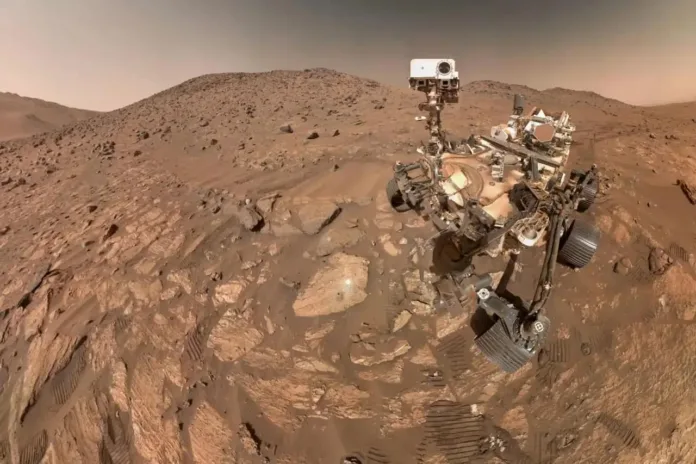

NASA has revealed the clearest signs of life on Mars ever after making an incredible rover discovery.
Evidence of ancient alien microbes have been uncovered in a dry river channel, scientists reported Wednesday.
A sample obtained by Nasa’s Perseverance rover found sediment on the bottom of a lake which points towards potential signs of ancient microbial life, according to scientists.
Researchers say the rocks contain tiny dark specks which are less than a millimetre in length and have been nicknamed “poppy seeds”.
Other sediments found contain larger dark-rimmed rosettes with lighter centres – dubbed “leopard spots”.
Both speckles are said to be rich in iron and phosphorus.
The age of the samples collected by Perseverance are estimated to be aged somewhere between 3.5 to 3.7 billion years old.
The rocks are now due to be taken for in-depth analysis.
The Perseverance – the same size as a standard car – has been roaming Mars since 2021.
It carries a drill to penetrate rocks and tubes to hold the samples gathered from places judged most suitable for hosting life billions of years ago.
The discovery is one of the best pieces of evidence to date about the possibility that Mars once harbored life.
Sean Duffy, the acting Nasa administrator, said: “A year ago, we thought we found what we believe to be signs of microbial life on the Mars surface.
“We put it out to our scientific friends to pressure test it, to analyse it – did we get this right? Do we think this is a sign of ancient life on Mars?
“After a year of review, they’ve come back and they said: ‘Listen, we can’t find another explanation.’
“So, this very well could be the clearest sign of life that we’ve ever found on Mars.”
One other potential reason for the discovery may be due to chemical processes which have taken place on Mars over millions of years.
This would, in theory, create similar rock forms which are made up from the same elements.
But experts believe the reactions appear to have occurred at cool temperatures – potentially pointing towards a more biological origin to the sediment.