

The Antigua and Barbuda Coalition for the Protection of Whales agrees with Ambassador Daven Joseph on an important point: Antigua and Barbuda should think for itself and determine its own future. But that principle applies equally to Antiguans like us who question the government’s position on commercial whaling. Calling our concerns—or those of overseas conservation NGOs—“colonial” does not answer the substantive questions about whales, fisheries, food security, or who actually benefits from this policy.
There is an irony in an argument about foreign influence that ignores Antigua and Barbuda’s exceptionally close relationship with a much larger foreign power on this issue. Japan, the world’s largest consumer of whale meat, is no longer a member of the IWC and therefore needs other countries to advance its longstanding goal of lifting the 40-year global ban on commercial whaling. After voting in lockstep with Tokyo for decades on Japan’s proposals for whaling quotas, apparently in return for US$200 million in development aid, Antigua has now assumed a leading role in Japan’s ongoing efforts at the IWC to lift the ban, rather than use its sovereign voice to advance the interests of Antiguans and Barbudans and the long-term health of our ocean.
We also agree with Ambassador Joseph that Antigua and Barbuda should make decisions based on sound science. Our fishers face genuine challenges, including changing ocean conditions driven by climate change that affect marine productivity. The answer to those challenges should be based on evidence about what actually limits the yield of our fisheries, and the evidence does not identify whales as the problem. Indeed, the whales that visit Caribbean waters—incidentally generating millions of dollars in tourism revenue for the region, including from the very foreign visitors he disparages—come to breed, give birth and rear their young, not to feed. The shift in his argument from “we need whales for food security” to “we need fewer whales because whales eat fish” may be neat rhetoric, but it is not supported by the science.
What the science
does
show is that healthy oceans with healthy fish populations need whales as nutrient vectors: through their movements and excretions they redistribute nitrogen, iron and other nutrients, helping support marine productivity: Their deep dives bring nutrients from deeper waters to the surface—the so-called “whale pump”—while their long-distance migrations transport nutrients between ecosystems. Recent research has shown that migrating whales move substantial quantities of nutrients from high-latitude feeding grounds toward tropical and subtropical breeding areas—our waters.
Ambassador Joseph also roots his defense in the UN Convention on the Law of the Sea. But he conveniently ignores that Articles 65 and 120 specifically allow for individual countries as well as the international community to prohibit the killing of marine mammals, including whales. Indeed, Antigua has exercised exactly that right under UNCLOS by prohibiting the killing of whales in its own waters. The IWC is not doing anything Antigua has not already done itself.
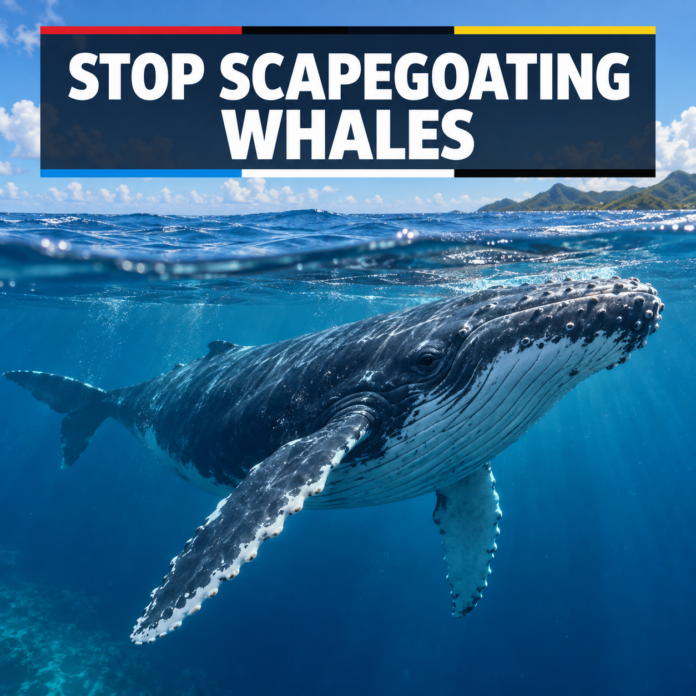
If we genuinely want an ocean policy based on evidence of what is good for Antigua and Barbuda—what will actually improve food security, support sustainable fisheries and protect livelihoods—killing whales, or supporting a whaling policy directed from Tokyo, is not the answer. So let’s stop scapegoating whales to avoid the more fundamental question of who is really driving Antigua and Barbuda’s policy on whaling.
Our government should make its policy on whaling based on what is best for our country, taking into consideration our citizens’ legitimate concerns for the protection of the whale populations and for our country’s reputation. For the people, by the people.
This article was originally published by Antigua News Room. Read the original article here: Whale Protection Coalition Urges Antigua and Barbuda to Stop Scapegoating Whales.