
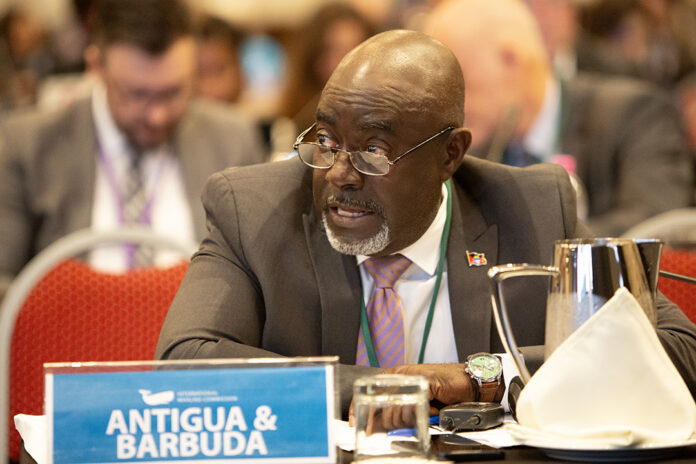

— Antigua and Barbuda is opposing proposed changes to quorum rules at the International Whaling Commission, warning that lowering the number of countries required to conduct business could weaken representation and disproportionately affect Small Island Developing States.
Ambassador Daven Joseph, Antigua and Barbuda’s commissioner to the IWC, outlined the country’s position as the commission considers changes to the rules governing the minimum number of members required for meetings and decision-making.
The issue is being considered at the IWC’s 70th meeting in Hobart, Tasmania, where the five-day plenary opened Monday. The commission said two quorum options were presented on the opening day and a drafting group was established to examine whether they could be merged into a single proposal.
Antigua and Barbuda, however, said neither option is acceptable in its current form.
The country strongly rejected an option that would define a quorum as a majority of members present at a meeting, arguing that the threshold should reflect the commission’s overall membership rather than the number of countries able to attend.
“Quorum must reflect 88, not who can afford airfare,” Antigua and Barbuda said in its statement.
The delegation argued that such a system could particularly disadvantage Small Island Developing States, which may face financial and logistical challenges in sending delegations to international meetings. It also maintained that a quorum should be maintained throughout the decision-making process rather than simply established when a meeting opens.
Antigua and Barbuda pointed to the potential numerical consequences of the proposal. Under the scenario presented in its statement, if 50 governments were attending a meeting, a quorum based on a majority of those present could fall to 26 — fewer than one-third of the commission’s 88 members referenced in the statement.
The delegation compared the proposal with rules used by several international fisheries organizations, saying bodies including the International Commission for the Conservation of Atlantic Tunas use quorum requirements tied more closely to their overall membership.
Antigua and Barbuda warned that adopting the proposed approach could leave the IWC with a substantially smaller group of countries able to conduct official business and make decisions.
The country also declined to support the second option in its present form.
That proposal would define a quorum as a majority of contracting governments whose delegations have been accredited or registered.
Antigua and Barbuda described that approach as better than basing the threshold simply on those present but said it still contains significant problems, including uncertainty over precisely what constitutes an accredited or registered delegation.
The statement questioned whether a government that registers a delegation online but ultimately does not attend would be counted and whether a country unable to accredit a delegation because of financial difficulties would effectively lose its place in calculating the quorum.
Joseph’s delegation also argued that the proposal would replace a fixed threshold with one that could fluctuate from meeting to meeting.
Under the current rule cited by Antigua and Barbuda, 45 members are required. If only 60 governments registered for a future meeting, the proposed formula could reduce the quorum to 31, according to the statement.
Rather than lowering the threshold, Antigua and Barbuda is proposing that the commission establish a small working group to examine the issue further.
The country wants the group to include representatives of Small Island Developing States, coastal states and different geographical regions and to work toward a consensus on changes to the quorum rules.
Among the measures proposed by Antigua and Barbuda is retaining 45 members as the minimum threshold for an IWC meeting.
It also wants the commission to require that a quorum be maintained throughout a session and for the chair to announce the number of members present before decisions are taken on matters including resolutions, amendments to the Rules of Procedure and changes to the commission’s Schedule.
Antigua and Barbuda has additionally proposed consideration of a higher threshold — potentially two-thirds of members — for decisions to amend the Rules of Procedure.
The delegation said any reform should strengthen representation across the IWC rather than make it possible for a smaller proportion of members to make decisions.
“Efficiency at 80 years must be balanced efficiency – not efficiency achieved by excluding members,” the statement said.
Antigua and Barbuda said it is willing to chair or co-chair the proposed working group and wants the existing 45-member requirement retained until a more broadly supported arrangement can be reached.
The debate comes during the IWC’s 80th anniversary year. The commission’s 70th meeting is being held in Hobart from Sept. 28 through Oct. 2, with representatives from its member governments and observer organizations considering issues ranging from whale population assessments to conservation and management proposals.
IWC records identify Joseph as Antigua and Barbuda’s representative, and the commission lists the country among its contracting governments.
This article was originally published by Antigua News Room. Read the original article here: Antigua and Barbuda Warns IWC Quorum Changes Could Sideline Small Island States.