
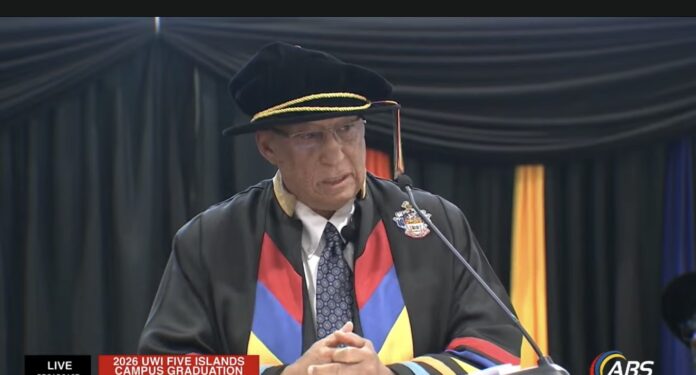

University of the West Indies Chancellor Doddridge Miller urged graduates in Antigua and Barbuda on Saturday to master artificial intelligence tools and commit to lifelong learning, warning that rapid technological change is reshaping careers and raising urgent questions about the Caribbean’s place in the global economy.
Addressing the graduating class of 2026 at the UWI Five Islands Campus, Miller said graduates must build on their university education as machines increasingly perform work once carried out exclusively by people.
“The most valuable skill you will have is not what you know today, it is your ability to learn tomorrow,” he said. “Learn these new tools, master them, question them.”
Miller said artificial intelligence, robotics, biotechnology and quantum computing were reshaping industries at a pace no generation had experienced. Tasks such as drafting, analysing, diagnosing and designing can now be performed quickly by machines, he said, while new careers are emerging and existing ones are being redefined.
The university itself is exploring incorporating artificial intelligence into its teaching and administration, he told the gathering.
For Caribbean graduates, Miller said, the challenge is no longer simply establishing a place in an interconnected world, but maintaining and expanding that place as technology changes the skills employers and societies need.
“So the question for a Caribbean graduate is no longer only, do we have a place in a global society?” he said. “More appropriately, it is, how do we keep that place and earn a bigger one?”
Miller encouraged graduates to become proficient users of AI, citing the argument that workers may be replaced less by the technology itself than by other people who use it effectively.
“It has been said that people will not so much be replaced by artificial intelligence as by other people who use it well,” he said. “Make sure you’re among those who use it well.”
He said the idea that a degree could provide all the preparation needed for a lifetime of work no longer holds.
“Your degree is a strong foundation, but it is the beginning of your education, not the end,” Miller said.
Drawing on cricket, he compared the technological transition to the arrival of the T20 format. Some players were left behind, he said, while those who succeeded retained their fundamental skills and added new approaches, fitness and thinking.
He pointed to the West Indies’ two world championship victories in the format as an example of adapting successfully without abandoning a strong foundation.
“This technological age is your T20 moment,” he told graduates. “The fundamentals you learn still matter, but you must add new strokes.”
Miller’s address developed themes from his previous two graduation speeches as chancellor. In 2024, he said, he spoke about belonging to a global society. In 2025, he urged graduates to claim their rightful place within it as builders, leaders and a stronger Caribbean voice.
This year, he said, the speed of technological change made it necessary to consider how the region would retain that place.
To illustrate the change, he revisited a story about an American driving a car designed in Germany, assembled in Mexico and built with materials from other countries. The example originally demonstrated the interconnected nature of everyday life.
In his updated version, the vehicle might drive itself, an algorithm would select the route, a digital assistant could replace a call to a stockbroker, and a machine might compose the music playing on the radio.
The global supply chain remained, he said, but nonhuman intelligence was becoming woven into its operations.
Miller offered graduates four guiding principles: continue learning, embrace technology while preserving their humanity, lead with character and ensure Caribbean representation, and remain resilient.
While encouraging technical competence, he argued that increasingly capable machines would make human judgment and values more significant.
“Artificial intelligence can process information, but it cannot replace wisdom,” he said. “It can identify patterns, but it cannot feel compassion. It can calculate possibilities, but it cannot decide what we value.”
Judgment, empathy, integrity and creativity would become more valuable as technology advanced, he said.
“The future belongs to those who combine technical skills with human insight,” Miller said. “Never let technology diminish what makes you human.”
He also warned that technological progress could carry unequal consequences. Tools capable of improving health care could deepen inequality, while platforms that connect communities could spread misinformation rapidly.
Miller said Caribbean participation in the development and oversight of AI systems was essential because those systems would help influence consequential decisions, including who receives a loan, a diagnosis, a job or a hearing.
“If they are built without us, they will not see us, our accents, our languages, our small markets, our reality,” he said.
He urged graduates to ensure that Caribbean data, stories and voices are included in the design and governance of emerging systems.
“That will not happen by accident,” Miller said. “It will happen because people like you insist on it happening and doing so with integrity.”
Despite those concerns, he described the technological shift as an opportunity for the Caribbean, arguing that it could reduce disadvantages traditionally associated with the region’s small size.
Engineers, entrepreneurs, artists and researchers in Caribbean cities can now develop products and ideas for the world without leaving home, he said.
Miller pointed to three UWI Five Islands students and graduates whom he credited with using artificial intelligence to develop solutions that could serve Antigua and Barbuda, the wider Caribbean and international markets.
“They are not waiting for the future, they are building it,” he said.
He challenged the graduating class to take on that responsibility.
“Do not simply participate in the future, help to create it,” Miller said.
The chancellor also reminded graduates that technological advances would not eliminate personal setbacks, disappointments or failure.
“Resilience is not the absence of difficulty,” he said. “It is the decision to keep going in the face of difficulty.”
He said the class had already demonstrated resilience by navigating disruption and uncertainty to complete their studies, and encouraged graduates to carry that strength into their professional and personal lives.
At the beginning of his address, Miller paid tribute to the late Five Islands Campus Council chairman, Sir Aziz Hadeed, describing him as a patron of the university and a source of strength for the young campus. He also welcomed the new chairman, Sir David Harrison.
Miller congratulated graduates on an achievement earned through late nights, difficult choices and sacrifice. He acknowledged the parents, families, lecturers and mentors who supported them, saying the celebration belonged to them as well.
Closing his address, he expressed hope that technologies, medicines, applications and ideas used around the world would increasingly be created in the Caribbean by UWI graduates.
“The future will not be shaped by technology alone,” Miller said. “It will be shaped by people, people with vision, integrity, courage, compassion, people like you.”
He urged the class to maintain its place in the changing world through continuous learning, principled leadership and a strong connection to its Caribbean identity.
“Go forward with confidence, humility, wisdom, and purpose,” he said.
This article was originally published by Antigua News Room. Read the original article here: UWI chancellor urges graduates in Antigua and Barbuda to master AI tools.