

— Prime Minister Gaston Browne says his administration is preparing tougher action against indiscriminate littering, unauthorised and unsightly roadside vending and derelict vehicles as part of a wider effort to leave Antigua and Barbuda with a wealthier, healthier and more cultured population.
Speaking Saturday on the Browne and Browne Show, Browne linked the planned enforcement measures to his government’s broader approach of using legislation and stronger enforcement to address social problems.
He pointed to the recent sitting of Parliament, where lawmakers dealt with tougher sentencing for firearm and sexual offences, and said the government intends to address other areas with similar determination.
“We had a very successful parliamentary sitting on Monday in which we addressed the issue of sentencing for firearm offenses as well as sexual offenses,” Browne said.
“We will be tackling some other issues pretty aggressively going forward, and I’m asking for the cooperation of our people.”
Browne then outlined what he described as his administration’s vision for the condition of Antigua and Barbuda when it eventually leaves office.
“We want to leave this country significantly better than we inherited it,” he said. “The people must be wealthier. They must be healthier. They must have a better environment in which to live. And we must have better cultured people.”
“That is what we have determined. This is where exactly we’re taking Antigua and Barbuda. And it’s not about political preservation in office.”
Browne suggested the government would be prepared to adopt measures that some residents may consider tough if officials believe they are necessary to change behaviour.
“So if we have to make the tough decisions in order to drag certain people forward, we’re going to do so,” he said.
One of the areas Browne singled out was indiscriminate littering, which has repeatedly been targeted by the government as it seeks to improve the appearance of communities and public spaces.
“And you see all this indiscriminate littering that is taking place within the country,” Browne said. “We will be literally increasing the penalties, and we’ll be ensuring that there’s enforcement.”
The comments follow a Cabinet decision in September to adopt what it described as a zero-tolerance approach to littering and illegal dumping.
Cabinet said at the time that the government intended to increase the penalty for littering to EC$5,000 and take the necessary legislative steps to implement the higher fine. The initiative also targets dumping, derelict vehicles and unauthorised use of roadsides, beaches and other public spaces.
Browne’s latest remarks suggest enforcement will be an important part of the initiative rather than relying solely on higher penalties.
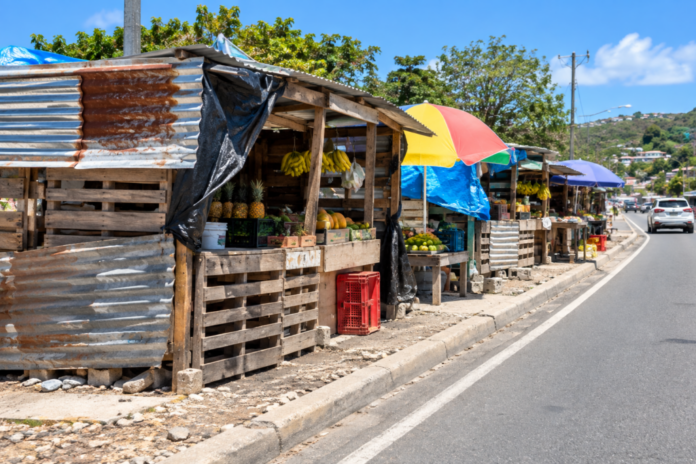
The prime minister said the government also intends to deal with what he described as indiscriminate vending.
“Even the issue of indiscriminate vending, that too will be addressed aggressively,” Browne said.
But he stressed that the objective is not to prevent people from earning a living.
“Now, we do not want to put anybody out of earning an income,” he said.
Instead, Browne objected to unauthorised and makeshift structures being erected along roadsides, particularly structures he believes diminish the appearance of the country.
He referred specifically to the use of pallets, discarded construction materials and galvanize to build small vending structures.
“This idea that individuals can just vend indiscriminately and to use pallets and other, you know, broken pieces of building material, galvanize and so on, and knock up these little shacks — that is not the image that we want Antigua to have, especially when our guests come here,” Browne said.
The government has previously taken action against unauthorised vending facilities, including approving the removal of unauthorised structures from public beaches while pursuing purpose-built facilities for vendors.
Browne said the appearance of the country is not merely a cosmetic issue but can affect how potential investors and visitors perceive Antigua and Barbuda.
He recounted a recent experience involving a prospective investor who visited Antigua to examine Jolly Beach with a view to transforming the property into a Ritz-Carlton development.
According to Browne, the investor was impressed with the government’s ambition to position Antigua and Barbuda as a high-end tourism destination but questioned the condition of some areas he encountered while travelling to Jolly Beach.
Browne said the visitor pointed to garbage and old vehicles along the roadside and questioned how those conditions could coexist with the country’s ambitions for luxury tourism.
The prime minister said he agreed with the criticism.
Government has already been demolishing derelict properties and removing abandoned vehicles, Browne said, but he complained that vehicles continue to be left along roadsides even as authorities remove others.
The wider clean-up effort predates Saturday’s remarks. Browne has repeatedly called for cleaner public spaces and argued that indiscriminate dumping and derelict properties undermine Antigua and Barbuda’s tourism product and residents’ quality of life.
Browne also signalled another legislative change aimed specifically at abandoned and derelict vehicles.
He referred to reports of vehicles being repaired along the new concrete road running from Jennings toward Hermitage and said those responsible would first be asked to remove them.
If they fail to comply, he said, the vehicles would be forcibly removed.
The prime minister said the government also intends to amend the law so that when the state spends money removing a vehicle, the cost can be attached to the relevant vehicle or personal licence.
Under the system outlined by Browne, the owner would have to settle the outstanding removal costs before being allowed to renew the licence.
Browne acknowledged that some people may regard such policies as excessive.
“People may consider these policies draconian,” he said. “They’re necessary to ensure compliance.”
He then challenged residents to consider what they want Antigua and Barbuda to look like over the next decade.
The government’s September clean-up policy similarly identified abandoned vehicles as both an environmental and public-safety concern and instructed government agencies to enforce laws governing their removal.
Browne’s remarks placed the clean-up and enforcement campaign within a much broader development strategy rather than presenting littering and vending as isolated problems.
His reference to a population that is wealthier, healthier and better cultured, along with a better physical environment, followed his discussion of the government’s investments in social infrastructure, including the new National Performing Arts Centre.
He argued that economic development must be accompanied by improvements in the country’s physical appearance, social standards and cultural development.
That approach, Browne suggested, could require government intervention where voluntary compliance has failed.
His administration has increasingly linked cleanliness and community appearance with tourism development, investment and living standards. Cabinet’s September policy called for stronger enforcement against indiscriminate dumping and unauthorised occupation of public spaces while also providing for public education and community clean-up initiatives.
For Browne, the measures form part of what he described Saturday as a long-term effort to determine what kind of country the current administration ultimately leaves behind.
“We want to leave this country significantly better than we inherited it,” Browne said. “The people must be wealthier. They must be healthier. They must have a better environment in which to live. And we must have better cultured people.”
This article was originally published by Antigua News Room. Read the original article here: PM Signals Tougher Action Against Littering and Unsightly Vending in Antigua and Barbuda.