

Embracing the Bilingual Antiguan and Barbudan
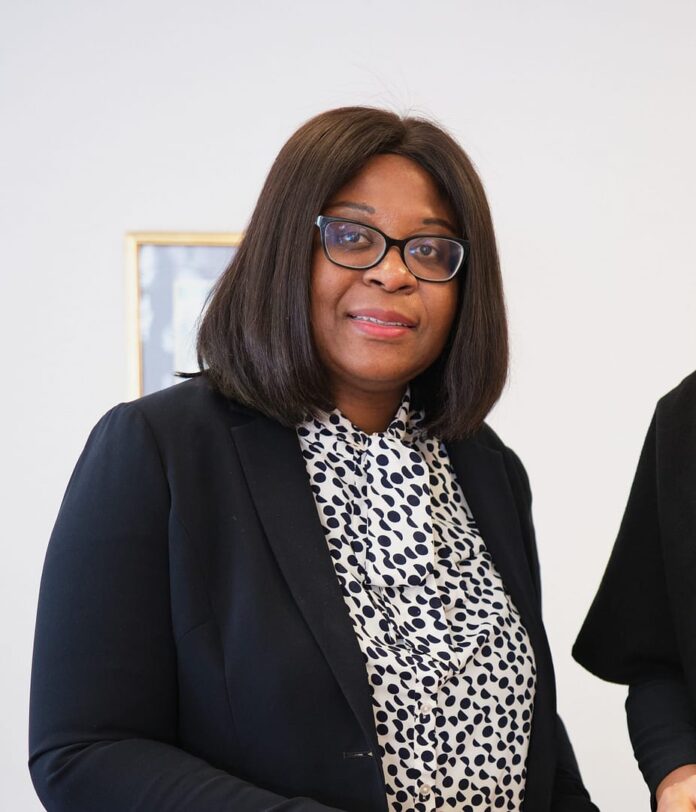
By H.E. Karen-Mae Hill, High Commissioner to the United Kingdom
The British linguist Frank Smith noted: “One language sets you in a corridor for life. Two languages open every door along the way”. I am among those who applaud the Government for embracing the unparalleled power of learning languages as a deliberate and focused strategy in our onward development as a Nation and as a people. Please allow me to share some personal perspectives on why I commend the decision to recognise Spanish as a second language.
My first foreign trip was to Guadeloupe during my high school days as part of my French studies. This experience stayed with me throughout my life as the reality of a huge and diverse world outside myself was vividly illustrated. Walking alongside a board walk in Basse-Terre, I saw a cat meandering along the path. As an avowed animal lover, I stooped down, stretched out my hand, and said “hey kitty, kitty””. The cat ignored me. Then I remembered this was a French cat and so, I re-oriented my brain into French and pronounced in my best French “Bonsoir, monsieur le Chat!” The cat paused, looked at me and I knew he understood.
Antigua and Barbuda is located in a region which is largely Spanish speaking. Central and South America are among our nearest geographical neighbours yet we have a limited connection with these countries because our history, shaped by our relationship with Britiain, has oriented our focus to the English-speaking West. The fact that many Antiguans and Barbudans have relations from the Dominican Republic, has not significantly altered this reality. My grandmother was born in Santo Domingo in the 1920s during that period when Antiguans and Barbudans migrated to that country to find work. I am not unique among Antiguans and Barbudans to have close relatives from the Dominican Republic and yet all our cousins in Antigua and Barbuda do not speak Spanish.
We are members of the Organisation of American States which has 35 member countries 19 of which or 54% are primarily Spanish speaking. We are also members of the Community of Latin American and Caribbean States (“CELAC”), a regional bloc of 33 countries, 18 of which or 55% are primarily Spanish-speaking. We are also members of the Latin America and Caribbean Group (GRULAC) with 19 of which or 58% are Spanish speaking. The Pan-American Health Organisation (PAHO) has four official languages: English, Spanish, Portuguese and French. With 18 of its 35 member countries being Spanish speaking most if its work programmes and publications are carried out in Spanish.
In attending meetings of these bodies, two things are evident. First is that the Caribbean desks in those organisations seldom include staff from Antigua and Barbuda. Our students and professionals have studied in Cuba and China over the years and many can rise to employment in these types of organisations but we need to develop that national ambition. Second, it is also noteworthy that most of our Spanish speaking colleagues are proficient in English and can navigate these meetings proficiently in either language. Belize is an excellent example of a country located in Spanish-speaking Central America which has English as its official language but a population where Spanish is widely spoken.
Participation and relationships are deepened when language is common. This builds trust, demonstrates understanding and opens up opportunities to engage and conclude agreements over a meal or in a corridor outside the formalities of the meeting and translators. Nelson Mandela captured this important quality of language as follows: “If you talk to a man in a language he understands, that goes to his head. If you talk to him in his language, that goes to his heart”.
With deeper relationships, come new possibilities to study and travel. This bilingual policy has the potential to open up the vast and under-tapped opportunities for study and tourism across Central and South America to students in Antigua and Barbuda. In a world where the cost of education is increasing and Western countries are signalling a more inward-looking approach to borders, identifying other credible options for our Antiguans and Barbudans to study in these parts of the world is critical.
It was in learning French that I found my deeper understanding of the grammar of the English language. The exercises of learning tenses from the pluperfect to the future, from adjectives to adverbs, actually taught the grammar and syntax of language in their most detailed form. With this came a passion for reading. I recall as a student studying my Bible and Sabbath school quarterly in French. It was always useful to compare how the French and the English interpretation compared especially in those popular passages such as the Lord’s Prayer and the 23rd Psalm. Indeed, I encourage our students who are church goers, to study their Bibles in both English and Spanish or whichever second or third language they are learning and to commit to memory their favourite passages in both languages.
This bilingual policy by our Government will open up enhanced avenues for study, travel, tourism, and business between Antigua and Barbuda and our Spanish speaking neighbours. I envisage more engagement across academic degrees, short courses and internships. Many South American countries are mass exporters of agricultural produce engaging cutting edge technologies to support these industries. Opening dialogue with Peru and Paraguay on courses as well as trade can all be strengthened through stronger language ties. Our engagements at GRULAC and CELAC should progress discussions on student exchanges, joint degree and technical skills programmes and trade promotion activities, connecting businesses and people. Indeed, leaning Spanish makes leaning Portuguese, spoken in Brazil, easier as they are both romance languages and share much of the same vocabulary.
If one were to look at the advertisements for most multilateral jobs in our region of Latin America and the Caribbean, there is usually a requirement for the applicant to possess a working knowledge of Spanish and English. Our people possess the intellect and capacity to secure employment in these organisations. However, the prospects of a successful deployment would be greatly improved with language skills. I look forward to seeing more Antiguans and Barbudans employed at the Organisation of American States, the Economic Commission for Latin American and the Caribbean (ECLAC), the Pan-American Health Organisation (PAHO) and the Development Bank of Latin America and the Caribbean (CAF).
The debate around the role that artificial intelligence will play in our present and future lives rages. Each week, there are discussions about AI proof jobs, those jobs which AI would likely never be able to replace. Among these are jobs rooted in language skills as these are jobs which require an intrinsic connection to human emotions such as empathy, cultural nuances and sensitive context. These are not replaceable by a robot.
As we look to the future with a bold and strategic vision, I encourage all Antiguans and Barbudans to embrace the opportunities to grow personally and together as a Nation. We are preparing citizens for the world. People who can champion our uniqueness and our priorities on the global stage. I am committed to supporting our Government, our education officials, our communities, our civil society organisations and our business sector to step into this renaissance anchored in our shared ambition to raise the standard and to raise it boldly.