
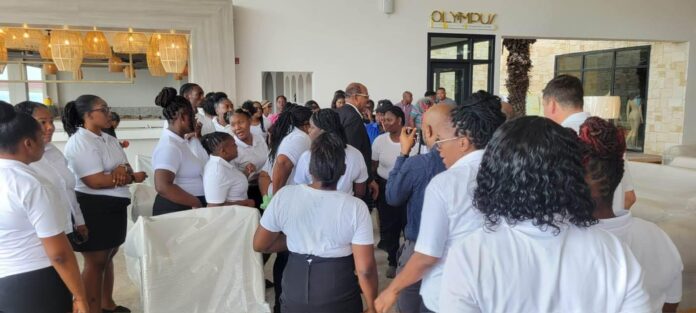

Pm interacting with hotel workers May 2024/File photo
Prime Minister and Antigua and Barbuda Labour Party leader Gaston Browne says his government is considering introducing a separate, higher minimum wage for hotel workers, arguing that the country’s largest industry should provide more stable and adequate incomes.
Speaking on Pointe FM’s Browne and Browne Show, Browne said the tourism sector, led by large hotel operators, should not be held to the same wage standards as smaller businesses with tighter margins.
“Companies like Sandals and Barrett Hotels… they too must have a minimum wage, a special one higher than the $2,200 that we planned for the other small businesses,” Browne said.
He suggested that hotel workers could see a minimum wage closer to $3,000 per month, significantly above the baseline being proposed for other sectors.
“Then they maybe should be at $3,000 minimum,” he said, adding that further consultations will take place before any final decision is made.
Browne indicated that discussions on the issue are already advanced, pointing to what he described as emerging agreement among stakeholders.
“I can tell you that already there is a consensus that there should be a separate minimum wage for hotel workers,” he said.
The proposal forms part of a broader shift toward what the government has described as a “livable wage” framework, which is expected to raise the minimum monthly earnings for public sector workers to about $2,200, with some workers moving closer to $2,500 after adjustments.
Browne argued that the current compensation structure in the hotel industry, which relies heavily on service charges and tips, leaves workers financially vulnerable and limits their ability to access credit.
“They must be able to afford a mortgage… and when they go to these banks, they say they can’t rely on your service charge,” he said.
He said a higher guaranteed base salary would provide workers with greater financial stability and reduce dependence on variable income.
“I don’t want a minimum wage under $2,000 and they have to rely on tips. We want real money. Our people must live good,” Browne said.
The prime minister also issued what he described as an early signal to the hotel sector, indicating that wage reforms could follow after the election.
“Me give out the hotels them warning… we’re going to fight for the hotel workers to make sure they make more money in this country,” he said.
Tourism remains the country’s largest economic sector, and Browne’s remarks suggest a potential policy shift that would place increased wage obligations on major industry players.
No timeline has been announced for implementation, and it remains unclear how such a measure would be structured or enforced.