
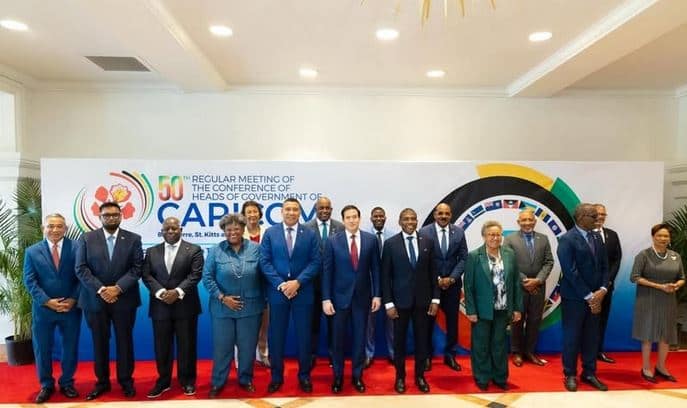

CARICOM leaders with U.S. Secretary of State Marco Rubio at the 50th Conference of Heads of Government of CARICOM in February 2026.
By Dr. Nand C. Bardouille
The Caribbean Community (CARICOM) is grappling with a protracted period of regional tensions, tied to the new normal in international politics. In some respects, this moment is the bloc’s toughest test yet.
At a time when the unity of CARICOM is under growing strain, marked by a discernible shift in respect of interactional norms and diplomatic coherence pertaining to the foreign policy realm, St. Kitts and Nevis took up the mantle of Chair of the bloc.
Arguably, the impacts of that strain on the regional grouping have had a profound effect on how Prime Minister of St. Kitts and Nevis Terrance Drew has approached his leadership role in CARICOM — on behalf of his country.
Drew is the Chairman of the Conference of Heads of Government of CARICOM — for a six-month term that got underway this past January. As the bloc’s constituent treaty notes: “The Conference shall be the supreme Organ of the Community.”
In this framing, regional priorities are the rotating chairmanship’s main focus. Perhaps most consequentially, Drew is discharging his regional leadership responsibilities at a juncture when CARICOM member states are facing up to emergent geopolitical dynamics that have driven a wedge between them.
A Wide (Foreign Policy) Gap
CARICOM member states’ duelling perspectives on the high-stakes “Trump Corollary” to the Monroe Doctrine became a consequential, foreign policy-related sticking point that placed the bloc in a months-long diplomatic rut.
This situation has weighed down the regional grouping, making its members’ efforts to cohesively contend with an international order that is undergoing a seismic change that much more difficult. (The international system last experienced change on such a scale at the Cold War’s end, which also precipitated the demise of bipolarity and ushered in the now erstwhile unipolar moment.)
While most CARICOM member states have responded to that Doctrine with suspicion and trepidation, some have offered full-throated support. The former subset of member states are standing their ground in respect of long-established CARICOM foreign policy-related principles, which hinge on the shared desire of such small states to respect processes of international cooperation and multilateralism.
In contrast, Trinidad and Tobago has controversially thrown its support behind Washington in respect of the spiralling U.S.-Israeli war with Iran — which has been quelled by a tenuous cease-fire for now. Instructively, early on in that conflict, Barbados called for “restraint as Middle East tensions intensify.”
This article was first published by the Jamaica Gleaner on April 16, 2026.