
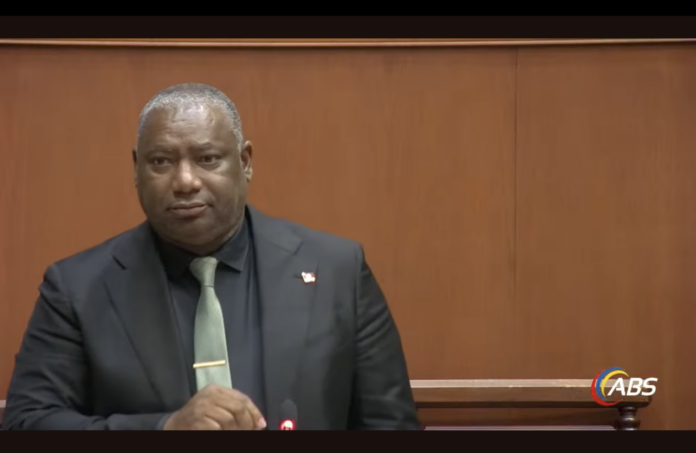

Senate Minority Leader Chester Hughes called Tuesday for Antigua and Barbuda to modernize its Labour Department and overhaul outdated labour legislation, arguing that isolated amendments will not fix the problems facing workers and employers.
Speaking during debate on the Limitation (Amendment) Bill 2026, the trade unionist urged the government to bring a comprehensive package of labour reforms to Parliament, including changes to the Labour Code and workers’ compensation legislation.
“We must bring Antigua and Barbuda’s labour protection legislation into the 21st century,” Hughes said.
He criticized what he described as a piecemeal approach to lawmaking, saying changes must be coordinated with improvements to the institutions responsible for handling workplace disputes.
Hughes said amendments to the Labour Code had been under consideration since before the United Progressive Party left office but had still not reached Parliament. He accused the National Labour Board of repeatedly revisiting the amendments without bringing the process to completion.
He also argued that workers’ compensation legislation remained rooted in the country’s cane-cutting era and needed to reflect the risks and realities of modern employment.
“All of these have to come to this Parliament,” he said.
Hughes said updating legislation alone would be insufficient without addressing staffing, equipment and case management at the Labour Department.
He described a department still using handwritten books to track cases, requiring staff to search through physical records for information about disputes.
“Modernize it, computerize it,” Hughes said.
He called for adequate staffing, training and technology to help the department handle complaints efficiently, stressing its importance to ordinary workers seeking redress.
Hughes argued that delays within the system often leave workers frustrated and can lead them to blame their unions for problems beyond the unions’ control.
He said reform should examine the entire process, from the Labour Department’s handling of complaints to hearings and decisions at the Industrial Court.
“We have to marry all the changes to make sure the system works efficiently and effectively in this country for workers,” he said.
While acknowledging that unions and employers would not agree on every reform, Hughes said the country needed a modern framework that served both sides.
He also signaled that he would challenge provisions in forthcoming Labour Code amendments that he believed employers were pushing at workers’ expense, whether from inside Parliament or through his work as a trade unionist.
This article was originally published by Antigua News Room. Read the original article here: Labour Department still using handwritten books to track cases, Hughes calls for digital system.