
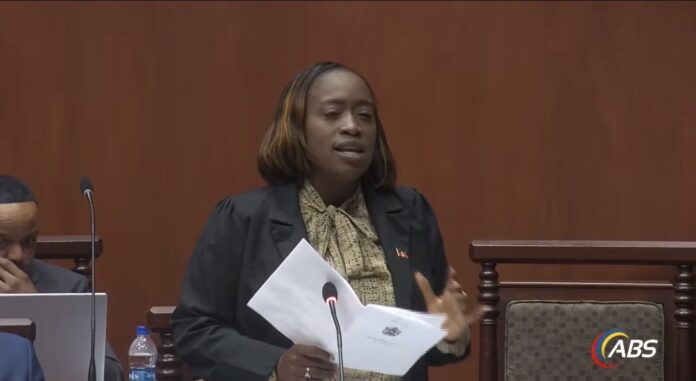

Sen. Shenella Govia has rejected claims that economic hardship and unemployment are driving young people into gun crime, arguing that jobs are available but some youths prefer “quick money” over honest work.
Govia, the leader of government business in the Senate, made the argument while presenting the Firearms Amendment Bill, 2026, which introduces tougher prison sentences for several firearm offences.
She accused the opposition of attempting to link the rise in violence to difficult economic conditions and youth unemployment.
“You can’t say that people don’t have work to do in Antigua and Barbuda,” Govia said.
She pointed to construction activity, new supermarkets and the growth of small businesses as evidence that the economy was providing opportunities.
“Every corner you drive in Antigua and Barbuda, construction is booming,” she said. “Construction only means people have money in their pockets.”
Govia said contractors and other business owners were struggling to find workers locally and, in some cases, had been forced to recruit people from overseas.
“These people don’t want to work,” she said. “Some of them, they want to stay on the block.”
Her comments came as she expressed concern about the number of teenagers and young adults allegedly becoming involved in firearm offences. Govia referred to newspaper reports involving suspects who were 18 and 19 and said two young men arrested in connection with the killing of a shopkeeper in Freemans Village were no older than 21.
She argued that some young people were turning to crime because they wanted money quickly to purchase expensive clothing and footwear, not because legitimate opportunities were unavailable.
“There’s work out there for everyone who wants to work,” Govia said. “But they don’t want to work hard. They want the quick money so they can buy the shoe.”
She encouraged young people who might not perform well academically to seek vocational training at the Harrison Centre, where they could learn skills such as mechanics and welding.
Govia also placed some responsibility on parents who accepted expensive items or financial assistance from unemployed children without questioning where the money came from.
She said some young men returned home with costly shoes and brand-name products and provided food for their households, while their parents remained unaware of — or failed to question — the source of the money.
“What kind of society are we raising?” she asked.
Govia said community intervention had also declined because people were increasingly afraid to correct young people and risk confrontations with them or their parents.
The senator cited the recent shooting death of a 21-year-old pregnant woman, the killing of a shopkeeper during a robbery and attacks on service stations as evidence of the seriousness of gun violence.
“Gone are the days where people are robbing and they take what they want and leave,” she said. “It’s a gun they put into your head, Madam President, and it’s becoming scary. This is not the Antigua and Barbuda that we know.”
Govia said the government had invested significant resources in security, including more than 200 additional surveillance cameras and equipment for the Antigua and Barbuda Defence Force to help protect the country’s borders.
She presented the Firearms Amendment Bill as another part of the government’s response, declaring that “enough is enough.”
The measure establishes minimum prison terms for several offences. A person convicted summarily of carrying a firearm or ammunition in a prescribed public place would face between five and 10 years in prison.
Police officers, Defence Force members, ONDCP personnel and other authorised law enforcement officers acting in their official capacities would be exempt. The minister could also exempt specified people or classes of people.
Govia said stronger punishment was necessary as the use of guns made robberies, disputes and public gatherings increasingly dangerous.
This article was originally published by Antigua News Room. Read the original article here: Govia rejects economic hardship as cause of youth crime in Antigua and Barbuda.