
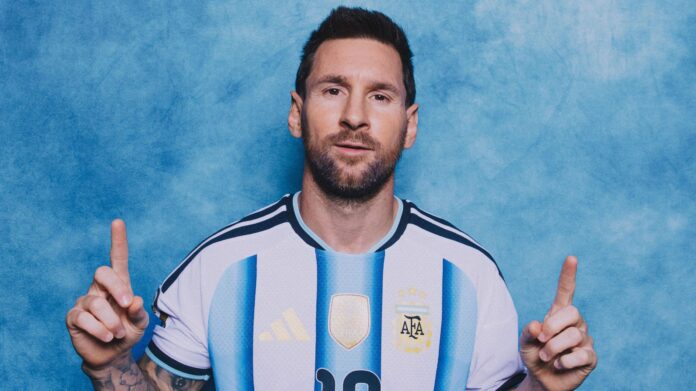

Some athletes conquer their sport, rare few transform it. Lionel Messi changed the way football could be imagined. He showed the world that greatness did not always have to arrive with noise, arrogance or physical intimidation. Sometimes greatness could be quiet. Sometimes it could stand modestly beneath the brightest lights, say very little, lower its head—and then produce something the world had never seen before.
Messi never appeared to fight against the game. Messi appeared to know what would happen before the ball reached him. His genius was not merely in his speed, balance or remarkable control. It was in his awareness—the extraordinary football IQ within all that chaos, the one path no one else could see.
Statistics can tell us how many goals he scored, but not how those goals made people feel. They cannot fully describe the silence just before he took a free kick, the sudden roar when the net moved, or the disbelief of supporters placing their hands on their heads after witnessing something beyond explanation. Records cannot measure the childhood dreams he inspired, the streets filled with children wearing the number ten, or the countless people who fell in love with football because they watched him play.
Messi gave supporters memories that became personal. People remember where they were when he dribbled past an entire defence. They remember the commentator’s voice rising with every touch. They remember the expectation whenever he received the ball near the penalty area—the feeling that ordinary rules were about to be suspended. For a few seconds, millions of people across different countries, cultures and languages would share the same thought:
Something extraordinary is about to happen.
And so often, it did. Yet the deepest part of Messi’s story is not found in effortless victories. It is found in the years of disappointment he endured while representing Argentina. For all his success at club level, international football repeatedly tested him. There were lost finals, painful comparisons and the burden of carrying the hopes of an entire nation. Every missed opportunity became a national conversation. Every defeat seemed to be placed upon his shoulders. At times, people questioned whether his story with Argentina would ever receive the ending his talent deserved.
But he returned. He continued to wear the shirt. He continued to accept the pressure. He continued to pursue the dream, even after that dream had broken his heart. That perseverance changed the meaning of his career, with the help of another Lionel of course. When Argentina finally reached the summit at the 2022 FIFA World Cup, the victory represented far more than the completion of a trophy cabinet. It was the release of years of longing—for Messi, for his teammates and for generations of Argentine supporters. You saw it when he dropped to his knees in Qatar.
The sight of Messi lifting the World Cup felt almost universal. It belonged first to Argentina, but it also belonged to every supporter who had followed his journey: those who had celebrated his brilliance, defended him through disappointment and hoped that football would eventually grant him that final moment. When he raised the trophy, it felt as though the game itself was honouring one of its greatest servants.
Not because he needed the World Cup to prove that he was extraordinary. But because, after giving football so many unforgettable moments, the universe had finally given one back to him. He made millions believe that limitations do not have to become endings. Children who were considered too small watched Messi and saw possibility. Introverted young players watched him and learned that they did not have to become someone else to command the world’s attention. Aspiring footballers watched him and understood that intelligence, discipline and imagination could be as devastating as raw power.
One day, football will continue without Lionel Messi on the field. New stars will emerge. New records will be established. But those who watched Messi will know that his influence cannot be contained within comparisons.
Because Messi was not merely a collection of achievements. He was a feeling. He was the anticipation that swept through a stadium when the ball reached his left foot. He was the moment a defender realised he had been beaten before understanding how. He was the roar of Barcelona, the hope of Argentina and the wonder of millions watching from every corner of the world.
He is the little boy from Rosario who grew into one of football’s largest symbols. Lionel Messi did not simply play the beautiful game, for an unforgettable period in football history, he became its most beautiful expression.
Messi is not Jesus. But on a football field? Sometimes it was real hard to tell.
Kendell Karan
Chaguanas
This article was originally published by Antigua News Room. Read the original article here: LETTER: Messi is Jesus.